Pay with Profits — Risk Tiers
How Risk Tiers work in Pay with Profits — tier thresholds, how your tier is determined, Dashboard tracking, and what it means for your Simulated Funded Account.
When you trade a Pay with Profits (PWP) Challenge, your trading behaviour determines your Risk Tier. The tier you're placed into sets the terms of your Simulated Funded Account, including the PWP Fee you pay, your Max Loss and Max Risk limits, and your Profit Share.
ℹ️ Risk Tiers only apply to the Pay with Profits model. Standard Challenges are not affected.
Your Risk Tier is locked the moment you pass the Challenge. It cannot be changed after that.
The five Risk Tiers
The Max Loss and Max Risk columns serve a dual purpose. During the Challenge, these thresholds are used to determine your tier based on your usage. On the Simulated Funded Account, they become the hard limits you trade with.
How your tier is determined
Your Risk Tier is based on two metrics tracked during the Challenge: your Max Loss usage (labelled "Max Drawdown" on the Dashboard) and your Max Risk usage. Each metric independently qualifies you for a tier, and you are placed in the higher tier. This is sometimes called the "worst-of-two" rule.
In practice, this means:
If your Max Loss usage is 3% (Low tier) and your Max Risk usage is 0.8% (Low tier), your tier is Low.
If your Max Loss usage is 3% (Low tier) but your Max Risk usage is 1.2% (Moderate tier), your tier is Moderate because the Max Risk usage placed you higher.
If your Max Loss usage is 7% (High tier) but your Max Risk usage is 0.4% (Very Low tier), your tier is High because the Max Loss usage placed you higher.
This encourages disciplined trading across both dimensions. Keeping one metric low doesn't offset high usage in the other.
Choosing a higher tier
When you pass the Challenge, you have the option to elect a higher Risk Tier than the one you qualified for. This is a one-time choice — once selected, it cannot be reversed.
For example, if your trading places you in the Very Low tier, you can choose to move up to Low, Moderate, High, or Very High instead. Choosing a higher tier means you'll trade with wider Max Loss and Max Risk limits on your Simulated Funded Account, but you'll also pay a higher PWP Fee and receive a lower Profit Share.
This only works upwards. If you qualify for the Moderate tier, you can move to High or Very High, but you cannot move down to Low or Very Low.
⚠️ Electing a higher tier is permanent. Make sure you're comfortable with the higher PWP Fee and lower Profit Share before confirming.
Tracking your tier on the Dashboard
Your current Risk Tier is shown in real time on the Dashboard. The Pay with Profits section displays your Max Drawdown and Max Risk usage side by side, each with a progress bar showing the tier thresholds. Your current tier is displayed at the top of the section and next to each metric.
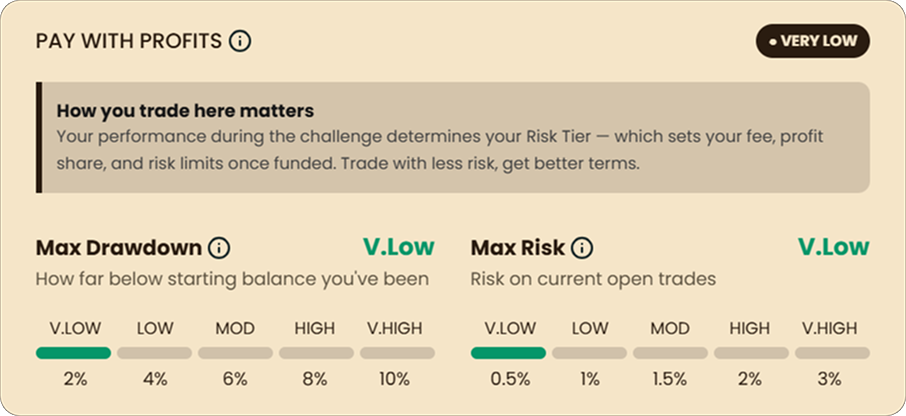
Every time you cross a tier threshold, it is logged immediately, and you'll receive an email notification. The email will show you which threshold was breached and your updated tier. This means you're never left guessing — you always know exactly where you stand.
The tier shown on the Dashboard reflects your peak usage, not your current drawdown. If your Max Loss usage hits 5% and then recovers to 1%, the Dashboard will still show you in the Moderate tier for that metric because the peak of 5% is what counts.
Challenge rules
During the Challenge, you trade with generous hard limits that give your strategy room to play out. These are the same for both Consistency and Endurance modes:
Your tier is determined by how much of the Max Loss and Max Risk you actually use. You don't need to stay within your desired tier's limits during the Challenge — those limits only apply once you receive your Simulated Funded Account. But the closer you trade to the limits, the higher your tier will be.
What each tier means for your Simulated Funded Account
Once you pass the Challenge, your Risk Tier sets three things on your Simulated Funded Account:
Max Loss limit — the maximum drawdown your account can sustain before it is breached. This is a hard breach.
Max Risk limit — the maximum risk you can have open at any time. This is also a hard breach.
Profit Share — the percentage of profit you keep on each payout. For details on how the PWP Fee is deducted and how payouts work, see the Payouts guide.
Lower-risk tiers receive tighter limits but a higher Profit Share and a lower PWP Fee. Higher-risk tiers receive more room but a lower Profit Share and a higher PWP Fee. The tradeoff is straightforward: trade with more discipline during the Challenge, and you'll be rewarded with better terms on the Simulated Funded Account.
Examples
Example 1 — Conservative trader on a $50K account
Both metrics stay very low throughout the Challenge, earning the best possible terms on the Simulated Funded Account.
Example 2 — Mixed usage on a $100K account
Max Loss usage qualifies for the Low tier, but Max Risk usage pushes the trader into the Moderate tier. The worst-of-two rule applies.
Example 3 — Aggressive trader on a $10K account
This trader uses most of the available headroom during the Challenge. Both metrics land in the Very High tier.
Frequently asked questions
Can I change my Risk Tier after passing the Challenge?
Can I change my Risk Tier after passing the Challenge?
No. Your Risk Tier is locked the moment you pass the Challenge. The tier is based on your peak Max Loss and Max Risk usage during the Challenge and cannot be changed or appealed once set.
Is the tier based on my final usage or my peak usage?
Is the tier based on my final usage or my peak usage?
Your peak usage. If your Max Loss usage hits 7% at any point during the Challenge, even if it recovers to 2% by the time you pass, your Max Loss tier is based on the 7% peak. The Dashboard always reflects your peak usage, not your current drawdown.
What if my Max Loss and Max Risk qualify for different tiers?
What if my Max Loss and Max Risk qualify for different tiers?
You are placed into whichever tier is higher. For example, if your Max Loss usage is Low but your Max Risk usage is Moderate, your overall tier is Moderate. This is the worst-of-two rule — both metrics matter.
Will I be notified when my tier changes?
Will I be notified when my tier changes?
Yes. Every time you cross a tier threshold during the Challenge, you'll receive an email notification immediately. The email will tell you which threshold was breached and what your updated tier is. You can also check your current tier at any time on the Dashboard.
Are the tier thresholds different for Consistency and Endurance?
Are the tier thresholds different for Consistency and Endurance?
No. The Risk Tier thresholds and Challenge rules are identical for both Consistency and Endurance modes.
Does the Max Daily Loss affect my tier?
Does the Max Daily Loss affect my tier?
No. The Max Daily Loss is a hard breach rule during the Challenge (set at 5%), but it is not used in the tier calculation. Only Max Loss usage and Max Risk usage determine your tier.
Related articles
Was this helpful?
Still need help? Share an idea